

Fiber optic connector is a device used to connect optical fibers, which connects two optical fibers to achieve the transmission of optical signals. It precisely connects the two end faces of the optical fiber to maximize the coupling of the optical energy output from the transmitting fiber to the receiving fiber, and minimize the impact on the system caused by its intervention in the optical link. This is the basic requirement of optical fiber connectors. To some extent, fiber optic connectors affect the reliability and performance of optical transmission systems.
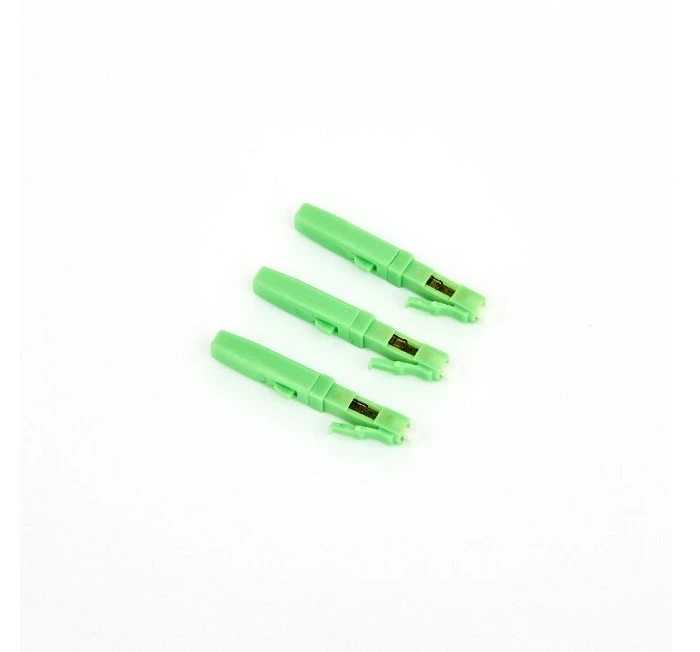
There are several connection methods for fiber optic connectors:
FC connector: FC connector is a commonly used fiber optic connector with a rotating connection method, which has high mechanical strength and stability, and is suitable for high-speed data transmission and video transmission scenarios.
SC connector: SC connector is a commonly used fiber optic connector with a push connection method, which has high mechanical strength and stability, and is suitable for scenarios such as data centers and local area networks.
ST connector: ST connector is a commonly used fiber optic connector with a rotating connection method, which has high mechanical strength and stability, and is suitable for scenarios such as data centers and local area networks.
LC connector: LC connector is a commonly used fiber optic connector with a push connection method. It has a small volume and high density, and is suitable for high-speed data transmission and video transmission scenarios.
MPO/MTP connector: MPO/MTP connector is a multi-core fiber optic connector with a push connection method, suitable for high-density fiber optic connections and data centers.
When choosing fiber optic connectors, the following aspects should be noted:
Fiber type: Different types of fiber connectors are suitable for different types of fibers, such as single-mode fiber connectors for single-mode fibers and multi-mode fiber connectors for multi-mode fibers. Therefore, when selecting fiber optic connectors, it is necessary to choose suitable fiber optic connectors according to the actual situation.
Connection method: There are various connection methods for fiber optic connectors, such as FC, SC, ST, LC, etc., and different connection methods are suitable for different application scenarios. For example, FC connectors are suitable for high-speed data and video transmission, while SC connectors are suitable for data centers and local area networks.
Transmission distance: Different types of fiber optic connectors are suitable for different transmission distances, such as single-mode fiber optic connectors for long-distance transmission and multi-mode fiber optic connectors for short distance transmission. Therefore, when selecting fiber optic connectors, it is necessary to choose suitable fiber optic connectors based on the actual transmission distance.
Performance requirements: Different application scenarios have different performance requirements for fiber optic connectors, such as insertion loss, reflection loss, coupling loss, etc. Therefore, when selecting fiber optic connectors, it is necessary to choose fiber optic connectors that meet the requirements according to the actual application scenario.
Cost considerations: Different types of fiber optic connectors have different prices, so when choosing fiber optic connectors, it is necessary to consider cost factors and choose fiber optic connectors with higher cost-effectiveness.
Brand reputation: Choosing a well-known brand of fiber optic connectors can ensure the quality and performance of the product, avoiding malfunctions and losses caused by quality issues.
It should be noted that fiber optic connectors are precision optical components that require special care during use to avoid damage to the connectors due to improper use. If a malfunction or abnormality is found in the fiber optic connector, it should be stopped from use in a timely manner and repaired or replaced.


